nationalist. "The white nationalists"白人民族主義者. by and large, suffice (it) to say, liberal, 以全新的視角評論諾蘭的《奧德賽》與過去的束縛 -
“我研究的白人民族主義者喜愛荷馬的《奧德賽》,因為他們認為這部作品表達了外國人的本質以及獨立於男性之外的女性的本質。”
"The white nationalists I study love Homer’s Odyssey for what they believe it expresses about the nature of foreigners and about women who live independently of men."
WHITE PEDESTAL author Curtis Dozier critiques Nolan's 'The Odyssey' from a new lens:

《白人基座》作者柯蒂斯多齊爾以全新的視角評論了諾蘭的《奧德賽》
諾蘭的《奧德賽》與過去的束縛 - 《匹茲堡書評》
White nationalism is a political and ideological movement that advocates for the preservation of a white national majority, often promoting the creation of a white ethnostate and opposing immigration and multiculturalism. [1, 2]
Core Ideology
- Definition: The belief that white people constitute a distinct race that should maintain dominance and demographic majority in historically white countries. [1, 2]
- Goals: Stricter immigration limits, racial separatism, or the mass deportation of non-white populations (remigration) to establish a "white-only" state. [1, 2]
- Connection to Supremacism: Analysts and civil rights organizations, such as the Southern Poverty Law Center, note that white nationalism heavily overlaps with or acts as a sanitized euphemism for white supremacy. [1, 2]
Recent Activity and Groups
- Patriot Front: A prominent neo-fascist and white nationalist organization founded in 2017. The group is known for flash-mob style demonstrations, distributing propaganda, and wearing standardized uniforms of khaki pants and dark shirts with face coverings. [1, 2, 3, 4]
- Washington, D.C. Marches: Masked members of the Patriot Front drew widespread national attention and sparked intense public debate when they marched through Washington, D.C., carrying American and Confederate flags during the country's 250th independence anniversary celebrations. A viral photograph of a Black woman composedly riding the metro surrounded by masked members became a defining image of the event, highlighting ongoing racial tensions and the public visibility of extremist groups. [1, 2, 3]
The New York Times and Washington Post lead with another good day in Wall Street as investors seemed desperate to turn anything that could be interpreted as good news into an excuse to buy. "The news, by and large, was bad--just not quite as bad as feared," notes the NYT
One occasionally meets material that is distributed so close to a normal curve that normal theory will suffice.
The criterion for decision in respect to a frame is whether a complete coverage thereof would suffice.
Such a poem was "Reluctance" with its nostalgic ending:
Ah, when to the heart of man was it ever less than treason
To go with the drift of things, to yield with a grace to reason,
And bow and accept the end of a love or a season?
Or:
Some say the world will end in fire,
Some say in ice.
From what I've tasted of desire
I hold with those who favor fire.
But if I had to perish twice,
I think I know enough of hate
To say that for destruction ice
Is also great
And would suffice.
The student anger, stoked through e-mail messages sent to large campus mailing lists, stems not so much from satisfaction with the Chinese government but from shock at the portrayal of its actions, as well as frustration over the West’s long-standing love affair with Tibet — a love these students see as willfully blind.
By and large, they do not acknowledge the cultural and religious crackdown in Tibet, insisting that ordinary Tibetans have prospered under China’s economic development, and that only a small minority are unhappy.
“Before I came here, I’m very liberal,” said Minna Jia, a graduate student in political science at U.S.C. who encouraged fellow students to attend the monk’s lecture. “But after I come here, my professor told me that I’m nationalist.”
“I believe in democracy,” Ms. Jia added, “but I can’t stand for someone to criticize my country using biased ways. You are wearing Chinese clothes and you are using Chinese goods.”
by and large
when everything about a situation is considered together:
There are a few small things that I don't like about my job, but by and large it's very enjoyable.
LIBERAL was found in the Cambridge Advanced Learner's Dictionary at the entries listed below.
- liberal (SOCIETY)
- liberal (POLITICS)
- liberal (GENEROUS)
- liberal (NOT EXACT)
- liberal arts
- Liberal Democrats
- the Liberal Party
By and large
Meaning
On the whole; generally speaking; all things considered.
Origin
Many phrases are wrongly ascribed a nautical origin just because they sound like mariner's lingo. This one really is and, like many such nautical phrases, it originated in the days of sail.
To get a sense of the original meaning of the phrase we need to understand the nautical terms 'by' and 'large'. 'Large' is easier, so we'll start there. When the wind is blowing from some compass point behind a ship's direction of travel then it is said to be 'large'. Sailors have used this term for centuries. For example, this piece from Richard Hakluyt's The Principall Navigations, Voiages, and Discoveries of the English Nation, 1591:
'By' is a rather more difficult concept for landlubbers like me. In simplified terms it means 'in the general direction of'. Sailors would say to be 'by the wind' is to face into the wind or within six compass points of it.
The earliest known reference to 'by and large' in print is from Samuel Sturmy, in The Mariners Magazine, 1669:
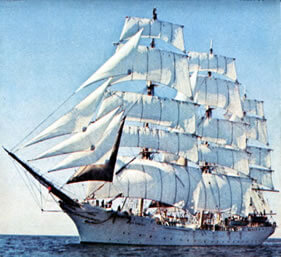 To sail 'by and large' required the ability to sail not only as earlier square-rigged ships could do, i.e. downwind, but also against the wind. At first sight, and for many non-sailors I'm sure second and third sight too, it seems impossible that a sailing ship could progress against the wind. They can though. The physics behind this is better left to others. Suffice it to say that it involves the use of triangular sails which act like aeroplane wings and provide a force which drags the ship sideways against the wind. By the use of this and by careful angling of the rudder the ship can be steered slightly into the wind.
The 19th century windjammers likeCutty Sark were able to maintain progress 'by and large' even in bad wind conditions by the use of many such aerodynamic triangular sails and large crews of able seamen.
The Phrase A Week newsletter goes out to 50,500 subscribers (35,500 by e-mail, 15,000 by RSS feed).Meaning
On the whole; generally speaking; all things considered.
Origin
Many phrases are wrongly ascribed a nautical origin just because they sound like mariner's lingo. This one really is and, like many such nautical phrases, it originated in the days of sail.
To get a sense of the original meaning of the phrase we need to understand the nautical terms 'by' and 'large'. 'Large' is easier, so we'll start there. When the wind is blowing from some compass point behind a ship's direction of travel then it is said to be 'large'. Sailors have used this term for centuries. For example, this piece from Richard Hakluyt's The Principall Navigations, Voiages, and Discoveries of the English Nation, 1591:
"When the wind came larger we waied anchor and set saile."When the wind is in that favourable large direction the largest square sails may be set and the ship is able to travel in whatever downwind direction the captain sees fit.
'By' is a rather more difficult concept for landlubbers like me. In simplified terms it means 'in the general direction of'. Sailors would say to be 'by the wind' is to face into the wind or within six compass points of it.
The earliest known reference to 'by and large' in print is from Samuel Sturmy, in The Mariners Magazine, 1669:
"Thus you see the ship handled in fair weather and foul, by and learge."
To sail 'by and large' required the ability to sail not only as earlier square-rigged ships could do, i.e. downwind, but also against the wind. At first sight, and for many non-sailors I'm sure second and third sight too, it seems impossible that a sailing ship could progress against the wind. They can though. The physics behind this is better left to others. Suffice it to say that it involves the use of triangular sails which act like aeroplane wings and provide a force which drags the ship sideways against the wind. By the use of this and by careful angling of the rudder the ship can be steered slightly into the wind. The 19th century windjammers likeCutty Sark were able to maintain progress 'by and large' even in bad wind conditions by the use of many such aerodynamic triangular sails and large crews of able seamen.
adjective
1 enough for a particular purpose:
This recipe should be sufficient for five people.
It was thought that he'd committed the crime but there wasn't sufficient evidence to convict him.
NOTE: The opposite is insufficient.
2 FORMAL have had sufficient to have eaten enough:
"Would you like some more stew?" "No thanks, I've had sufficient."
sufficiently
adverb
McGeechan has not recovered sufficiently to play in the semi-final tomorrow.
The case was sufficiently serious to warrant investigation by the police.
sufficiency
noun [S] FORMAL
an amount of something that is enough for a particular purpose:
"More ham, Mr Fletcher?" "No thank you - it was delicious, but I've had a sufficiency (= I have eaten enough)."
suffice
verb [I] FORMAL
to be enough:
I'm taking four hundred pounds' worth of travellers' cheques - I think that should suffice.
suffice (it) to say
it is enough to say:
Suffice (it) to say, Mike won't be going to Tina's birthday party after what he said about her to her boss.
by and large
when everything about a situation is considered together:
 by and large 全般的に, どの点から見ても; 概して.
There are a few small things that I don't like about my job, but by and large it's very enjoyable.

沒有留言:
張貼留言